How does the physical substantiality of wood panel art enhance its display presence and spatial interactivity?
Publish Time: 2025-12-03
Within the diverse media of contemporary visual art, wood panel art continues to captivate artists and audiences with its unique material properties. Unlike thin paper, pliable canvas, or cold metal sheets, wood panels inherently possess a grounded, warm, and historically resonant physical presence—they are not merely surfaces for images but tangible objects that can be perceived, touched, and even "conversed with." This physical heft, endowed by the material itself, not only strengthens the work's role as a visual anchor within a space but also profoundly influences the interactive dynamic between the viewer and the piece. This allows wood panel art to transcend the limitations of the two-dimensional plane, evolving into a comprehensive art form that integrates sculptural qualities, tactile appeal, and an ability to engage in environmental dialogue.
1. Substantiality as Presence: The Spatial Anchoring Power of Wood Panel Art
In modern exhibition spaces, walls are often covered with an abundance of lightweight prints, digital screens, or thinly stretched canvases, resulting in dense visual information that lacks material presence. A meticulously crafted wood panel art piece, however, with its thickness, weight, and three-dimensional edge construction, naturally possesses an ability to "occupy space." It is not simply "hung on the wall" but rather "embeds" itself into or "protrudes" from the space, creating a subtle yet undeniable three-dimensional intervention.
This physical presence is first evident in the establishment of a visual focal point. Upon entering a gallery, a viewer's gaze is instinctively drawn to works possessing volume and mass. The edge contours, side textures, and even the back panel structure of wood panel art can serve as visual cues, prompting the viewer to perceive its uniqueness from a distance. Particularly when multiple wood panel works are displayed in a staggered arrangement, or when a single large-scale piece is presented independently, their substantiality generates a strong field effect, transforming the artwork into a "landmark" within the space, rather than mere background decoration.
Furthermore, the thickness of the wood panel allows artists to reimagine the edges of the composition. Some works extend carvings or imagery to the sides, allowing the visual field to "wrap around" the entire wooden form; others retain raw saw marks, charred textures, or visible joinery seams, turning the sides into an integral part of the narrative. This attention to the "non-frontal" aspects breaks the conventional viewing habit of focusing solely on the picture plane, encouraging viewers to walk around, draw near, and examine the piece from multiple angles, thereby activating a dynamic relationship between the work and its surrounding space.
2. The Tactile Invitation: Extending Perception from Visual to Physical
The substantiality of wood panel art impacts not only vision but also stimulates a tactile imagination. The inherent warmth, roughness, grain patterns, or hand-polished smoothness of the wood evokes a sensory memory or anticipation of texture in the viewer's mind, even without physical contact. This "tactile potential" is something paper or digital images can scarcely achieve.
Within the contemporary art context that emphasizes "immersive experience," the tactile qualities of wood panel art are particularly significant. It invites the viewer to step closer, to gaze intently, and even sparks an impulse to reach out and touch—even if actual contact is prevented for conservation reasons, this desire for physical engagement transforms passive observation into active, bodily contemplation. The viewer is no longer merely a distant "observer" but becomes a potential "participant." This interactivity is especially notable in public art or educational settings: children may be curious about the panel's thickness, designers may study its structural logic, and collectors might assess craftsmanship by appreciating its weight and solidity. Wood panel art thus becomes a bridge connecting artistic expression with everyday sensory perception.
Pushing further, some contemporary artists deliberately accentuate the tactile properties of wood. For instance, they may leave areas of raw, unvarnished wood on the surface, allowing viewers to visually "sense" its dryness and coarseness; or incorporate recessed, raised, or carved-out structures that create shifting light and shadow with changing viewpoints, generating dynamic tactile suggestions. These techniques translate "heaviness" or "solidity" into a language understood by the body, ensuring the artwork is not only seen but also "felt" within the space.
3. Material Dialogue: The Symbiotic Relationship Between Wood Panel and Environment
The substantiality of wood panel art is also reflected in its interaction with the exhibition environment. Wood is an organic, "breathing" material that expands and contracts slightly with changes in temperature and humidity, while its color gradually deepens through oxidation over time. This temporality and environmental sensitivity mean that wood panel art is not a static object, but rather a living entity that "grows" and changes in dialogue with its space.
In galleries with ample natural light, the warm tones of wood gently reflect illumination, avoiding harsh glare and fostering a serene, introspective atmosphere. Within industrial-style concrete spaces, the inherent warmth and texture of wood provide a complementary contrast to the (cold, hard feel), creating a dialogue of materials. Even in outdoor temporary installations, wood panel art, through its structural strength and treatments for weather resistance, can maintain its form against the elements, becoming an intermediary object between nature and human creation.
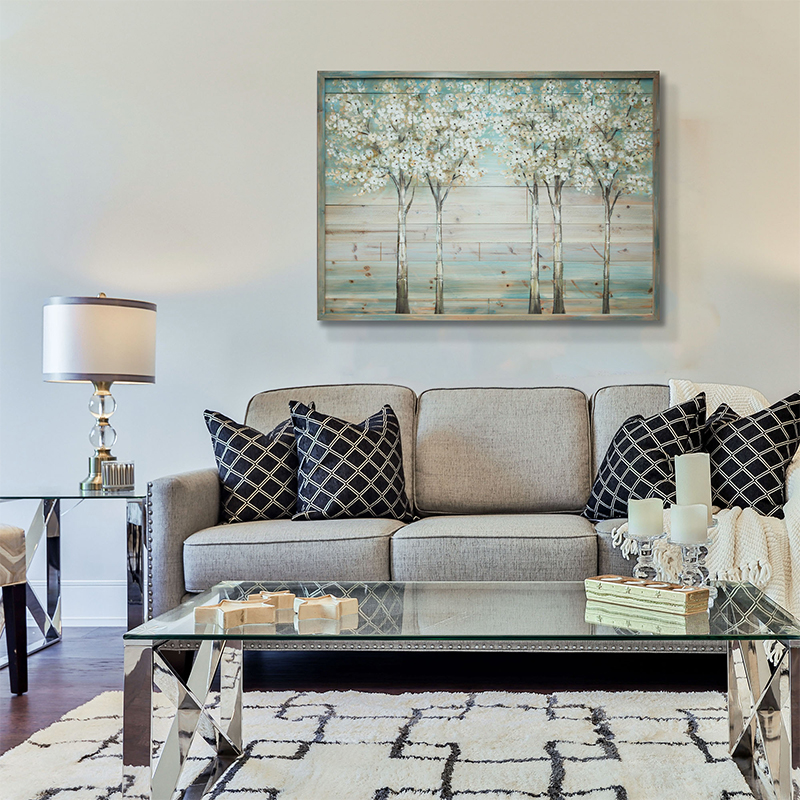
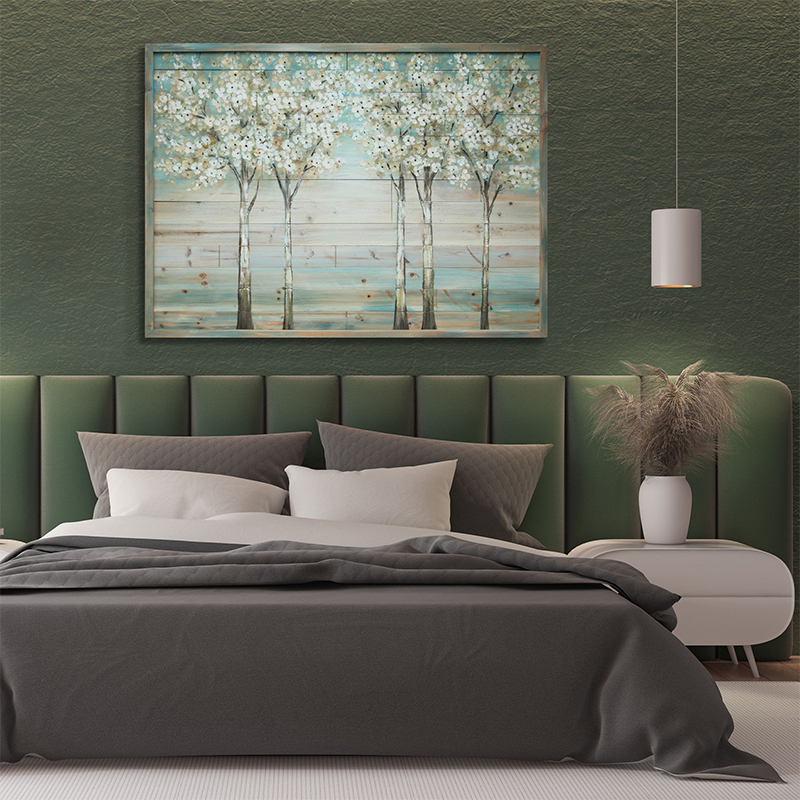
Moreover, the physical robustness of wood panels expands their possibilities for non-traditional display methods. They can be leaned against a wall, placed on a floor stand, suspended in mid-air, or even function as a screen or room divider integrated into the architectural space. This flexibility breaks the convention that "art must hang on the wall," allowing the work to become an integral part of the spatial composition. For example, if a large-scale wood panel artwork depicting, say, a pear blossom tree, is positioned in the center of a gallery, viewers can walk around it, experiencing the carving marks, wood grain, and play of light and shadow from all sides. In this scenario, the piece is no longer merely a "viewed object" but an organizer of spatial experience.
4. Cultural Weight: The Historical Resonance of the Material
Finally, the sense of weight associated with wood panels stems not only from their physical dimension but also from their profound cultural heritage. From medieval altarpieces and early Renaissance tempera paintings to Japanese ukiyo-e prints and 20th-century Expressionist works, wood has consistently served as a vital medium for expressing faith, recording history, and exploring form. When a contemporary artist chooses to work on wood panel, he or she is not merely selecting a material but is also engaging with and responding to a millennia-spanning artistic tradition.
This historical weight intangiblyenhances the work's sense of seriousness and depth. When facing a wood panel artwork, a viewer may subconsciously connect it to ancient artisans, the devotion of handcraft, and the primal power of image and material unified. This cultural resonance further amplifies the artwork's "presence" within a space—it is not merely a creation of the present moment but a link in the long chain of time.
The physical substantiality of wood panel art is far more than simple "thickness" or "weight"; it is a composite existence that blends materiality, temporality, tactility, and cultural significance. It grants the work a stronger visual anchoring force within a space, stimulates the viewer's bodily participation, fosters an organic dialogue with the environment, and carries historical echoes that transcend the immediate present. In an era increasingly characterized by virtualization and flatness, wood panel art, with its (solid, firm) material presence, reminds us that true art concerns not only the image but also how the object itself coexists with people, space, and time. It is precisely for this reason that a simple, unadorned wood panel, while quietly narrating on the wall, possesses the power to profoundly impact the entire space around it.